
Photographing KAFD with the Fujifilm GFX100 II
/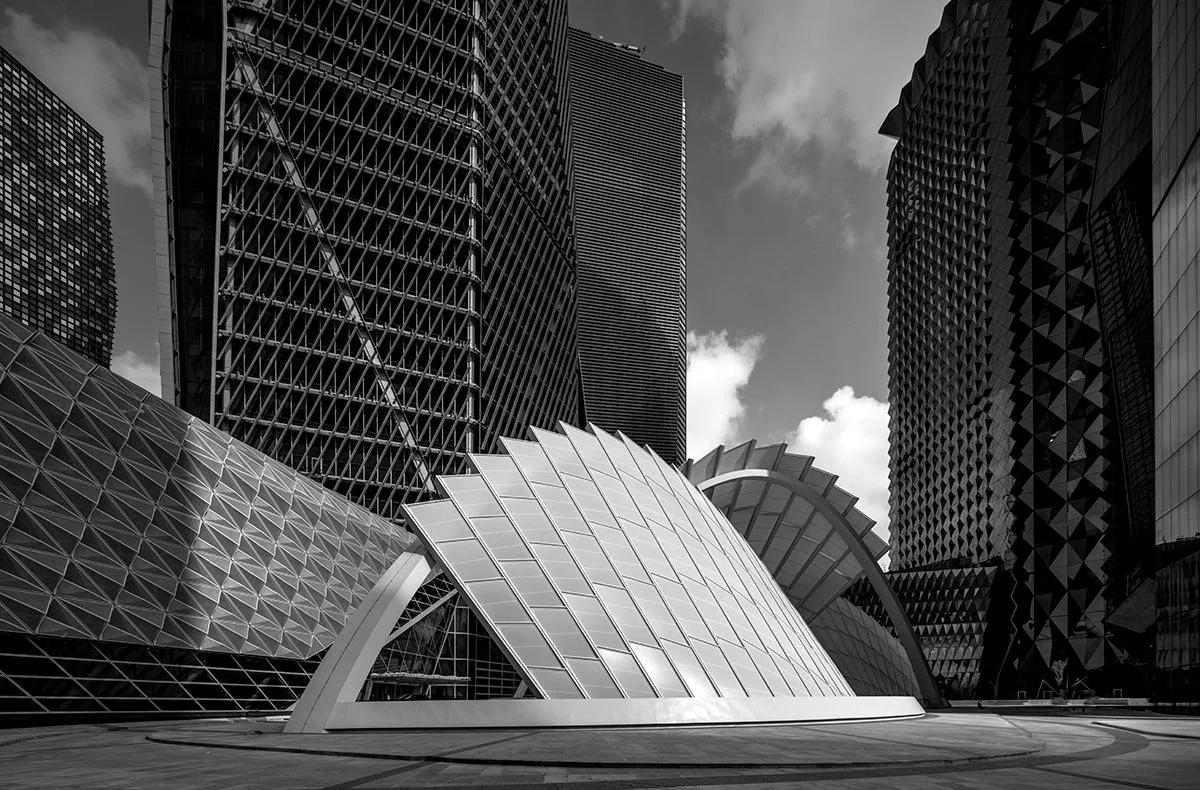
Fuji GFX 100 II + GF 30MM Tilt-shift
King Abdullah Financial District, known as KAFD, provided the setting for this architectural photography project in Riyadh. Working with the Fujifilm GFX100 II and GF tilt-shift lenses, I explored the relationship between architectural form, perspective and composition.
For me, architectural photography begins with understanding the space. Camera position, light and framing all influence how a building is represented. The equipment supports those decisions, providing the control needed to translate a three-dimensional structure into a considered photograph.
Controlling Perspective
Perspective is an important part of photographing architecture, particularly when working with tall buildings. A shift lens allows the framing to move upwards or sideways while the camera remains level, helping preserve parallel vertical lines.
Tilt serves a different purpose, changing the orientation of the plane of focus. Understanding the distinction between these movements makes it easier to choose the adjustment that a particular composition requires.
The FUJINON GF30mmF5.6 T/S offers a wide-angle view suited to architectural spaces, while the GF110mmF5.6 T/S Macro provides a longer focal length for tighter compositions and details.
Looking Beyond the Whole Building
An architectural photograph does not always need to show an entire structure. The relationship between surfaces, the repetition of lines or the meeting point of different forms can communicate something distinctive about the design.
At KAFD, the photographic possibilities extend from wider views of the district to more selective studies of its architecture. Exploring those different scales is part of what makes a location like this rewarding to photograph.
Equipment and Approach
This project brings together the Fujifilm GFX100 II and the perspective and focus controls of the GF tilt-shift lenses. Those tools offer flexibility, but the photograph still depends on where the camera is placed, how the scene is composed and when the light supports the subject.
Finish with a link to your KAFD portfolio so readers can move from the equipment and process to the finished photographs.


